
Preparing trade show graphics for print
Artwork that looks perfect on a laptop screen can print badly at two metres tall. This guide covers the technical side of trade show graphics so your files are ready for our London workshop first time.
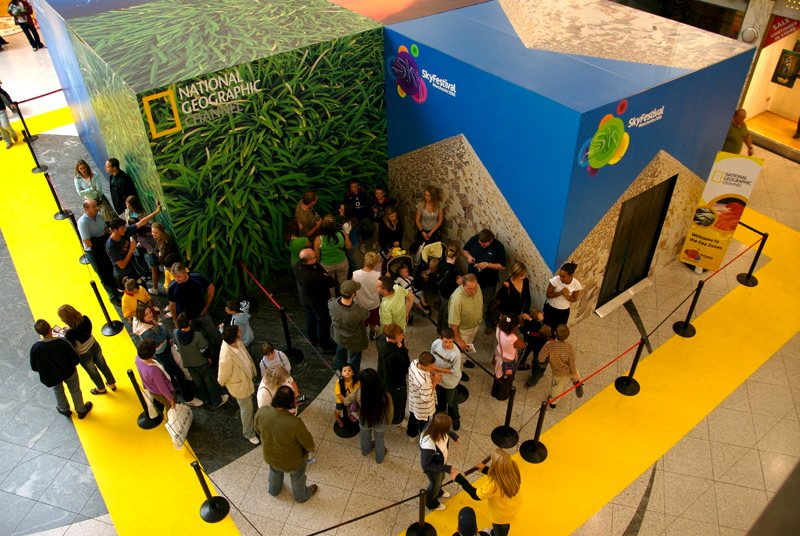
Always start from the right template
Every display system has its own panel sizes, visible areas and bleed. A pop-up panel that wraps around the end of a curved frame is a different size from the flat panels in the middle, and a roller banner hides part of the graphic inside its base. Ask us for the template for your hardware before designing. If you are not sure what system you own, send a photo and any labels on the case.
Resolution for large format
Large prints are viewed from further away than a brochure, so they do not need print-brochure resolution at full size. As a general guide, images placed at 100 to 150 dpi at final size print well for display graphics. Logos and text should be vector wherever possible, so they stay sharp at any size. Low-resolution images pulled from websites are the most common problem we see. Run your file through our proof checker before sending it.
Bleed, safe areas and joins
- Extend background colours and images past the trim line by the bleed shown on the template.
- Keep text and logos inside the safe area, away from edges, folds and wraps.
- On multi-panel walls, avoid placing faces or small text across a join between panels.
Colour
Supply artwork in CMYK or tell us your brand references so we can match them. Very rich blacks and certain bright colours, such as vivid oranges and blues, can shift between screen and print. If colour accuracy is essential, ask for a printed proof of key colours before the full run.
File formats and sending
A press-quality PDF with fonts embedded is the safest format. Name each file with the panel position, such as "left-end" or "panel-3", so nothing is printed in the wrong order. Large files can be sent through our upload tool. If any of this feels daunting, our in-house designers can set up the files for you, or adapt existing booth graphics to a new display.
Questions
What happens if my images are too low resolution?
We will tell you before printing. Sometimes the image can be used smaller, replaced with a better original or rescanned from a print or slide. Printing it anyway would give a soft or blocky result at large sizes.
Can I send artwork as a Word or PowerPoint file?
We can work from these, but they are not ideal for print. Our studio can rebuild the layout properly for large format, which is usually quicker than trying to fix the original file.
Tell us what you need printed
Give us the size, the material and the date you need it. We will check your files and send a quote.
0203 026 0636